Le dosage exact du jus de citron pour rattraper ou réussir sa mayonnaise maison
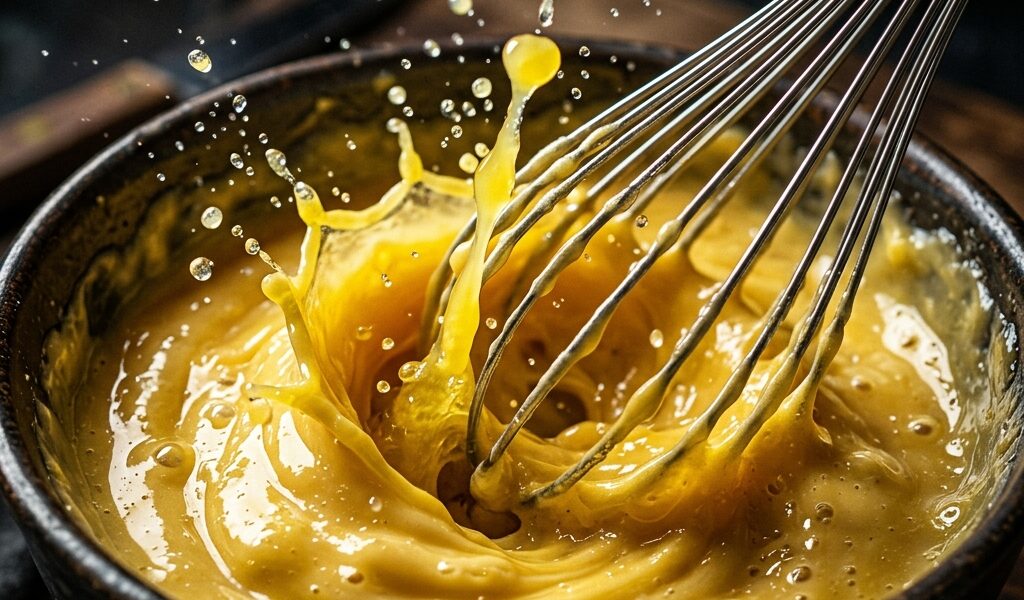
Réussir une mayonnaise maison est une source de fierté pour tout cuisinier, mais sa réalisation peut parfois être capricieuse. Si la texture reste liquide ou si l’émulsion “tourne”, la mayonnaise est ratée. La plupart des recettes traditionnelles intègrent du jus de citron. Quel est le dosage exact de ce liquide acide et quel rôle joue-t-il pour stabiliser l’émulsion ou rattraper une mayonnaise qui refuse de prendre ?
Réponse rapide : Pour une mayonnaise classique à base d’un jaune d’œuf, le dosage idéal est d’une cuillère à café (environ 5 ml) de jus de citron frais. Le jus de citron apporte l’eau nécessaire pour initier la suspension des gouttelettes d’huile et son acidité modifie la charge des protéines du jaune d’œuf (lécithine), facilitant leur rôle de tensioactif émulsifiant. Pour rattraper une mayonnaise ratée, battez une cuillère à café de jus de citron tiède au fond d’un bol propre et incorporez-y la mayonnaise ratée petit à petit.
L’explication scientifique : Émulsion colloïdale, tensioactifs et micelles
La mayonnaise est une émulsion de type huile-dans-eau (H/E). Le jaune d’œuf apporte des agents tensioactifs naturels, principalement des phospholipides (lécithine) et des lipoprotéines (LDL). Ces molécules possèdent une tête hydrophile (attirée par l’eau) et une queue hydrophobe (attirée par l’huile). Elles se positionnent à l’interface des gouttelettes d’huile pour former des micelles stabilisées, empêchant la coalescence (la fusion des gouttelettes d’huile).
Pour créer une émulsion, il doit y avoir une phase aqueuse continue dans laquelle disperser l’huile. Un jaune d’œuf contient de l’eau, mais l’ajout de jus de citron apporte une phase aqueuse mobile indispensable. Si vous manquez d’eau, les gouttelettes d’huile se touchent et l’émulsion s’effondre. De plus, l’acide citrique abaisse le pH de la préparation. Ce pH acide charge positivement les acides aminés des protéines du jaune d’œuf, provoquant leur répulsion mutuelle. Les protéines s’étalent plus facilement autour des gouttelettes d’huile, ce qui augmente la viscosité et renforce la stabilité physique de la mayonnaise.
Retour d’expérience : Rattrapage d’une émulsion cassée
Un jour où j’incorporais mon huile trop rapidement, ma mayonnaise s’est transformée en un mélange d’huile flottant sur du jaune d’œuf coagulé : elle avait complètement tourné. Au lieu de tout jeter, j’ai appliqué la technique de physique culinaire. Dans un bol propre, j’ai versé 5 ml de jus de citron frais. J’ai prélevé une cuillère de la mayonnaise ratée et je l’ai fouettée vigoureusement dans le jus de citron. Une émulsion blanche et ferme s’est immédiatement reformée au fond du bol. J’ai ensuite ajouté le reste du mélange raté très lentement, tout en fouettant. En moins de 2 minutes, ma mayonnaise était impeccable, ferme et aérée, avec une agréable fraîcheur en bouche apportée par le citron.
Conclusion
Le jus de citron n’est pas un simple exhausteur de goût dans la mayonnaise ; c’est un agent physique stabilisant essentiel à la structure même de l’émulsion. Utilisez-le au bon dosage pour garantir la réussite de vos sauces.