Ceviche et tartares : le jus de citron “cuit-il” vraiment le poisson cru ?
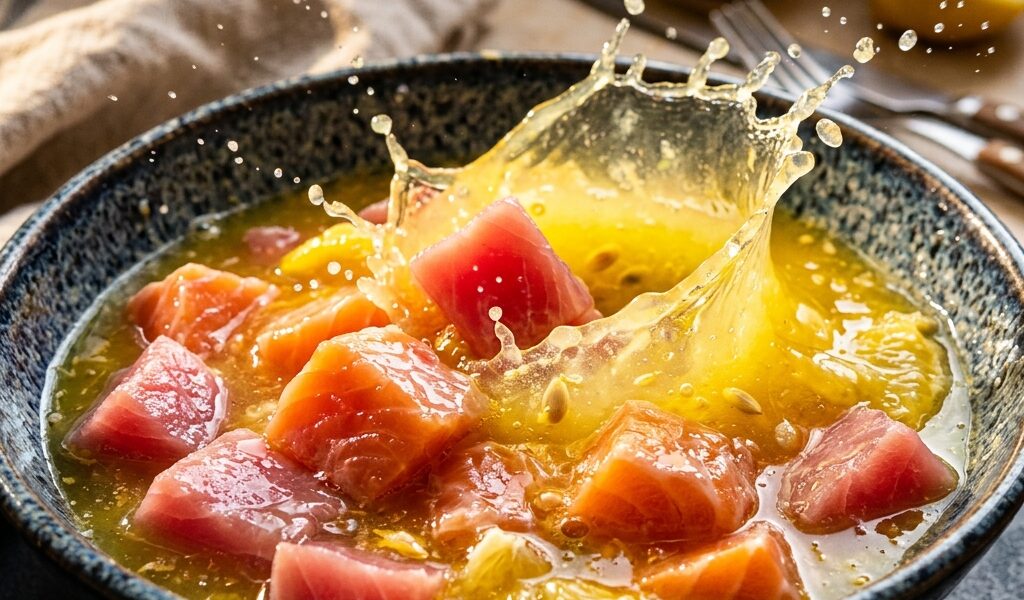
Le ceviche, plat traditionnel d’Amérique latine, met à l’honneur des morceaux de poisson cru qui, après avoir mariné dans du jus de citron vert ou jaune, prennent une couleur blanche opaque et une texture ferme semblable à celle d’un poisson cuit à la chaleur. Cette transformation visuelle spectaculaire conduit souvent à affirmer que le jus de citron “cuit” le poisson. Est-ce une réalité biologique ou une illusion culinaire ? Que se passe-t-il sur le plan moléculaire ?
Réponse rapide : Non, le jus de citron ne cuit pas le poisson au sens thermique et sanitaire du terme. L’acide citrique provoque une dénaturation chimique des protéines de la chair (ce qui lui donne son aspect blanc et sa fermeté), mais il ne chauffe pas le poisson et ne détruit pas les parasites pathogènes (comme l’Anisakis). Pour consommer un ceviche en toute sécurité, utilisez impérativement du poisson ultra-frais ou préalablement congelé.
L’explication scientifique : Dénaturation des protéines myofibrillaires et limites parasitaires
La “cuisson” par le froid ou par l’acide est en réalité une dénaturation des protéines. Les muscles du poisson sont constitués de protéines myofibrillaires, principalement la myosine et l’actine, repliées en structures tridimensionnelles complexes stabilisées par des liaisons chimiques faibles (liaisons hydrogène, ponts disulfures).
Lorsque le jus de citron (riche en protons H+) pénètre la chair du poisson, l’acidité modifie l’état d’ionisation des chaînes d’acides aminés. Les charges électriques se repoussent, provoquant le déroulement et la perte de la structure native des protéines. Ces protéines dénaturées s’agrègent ensuite en un réseau désordonné qui réfléchit la lumière (rendant la chair opaque et blanche) et emprisonne l’eau, modifiant la fermeté de la texture. C’est exactement le même résultat visuel et physique que la cuisson par la chaleur. Cependant, la chaleur détruit les liaisons covalentes fortes et tue les bactéries et les larves de parasites par hyperthermie. L’acide citrique, bien qu’il réduise la charge bactérienne de surface, n’est pas suffisant pour éliminer les parasites logés au cœur des fibres du poisson.
Retour d’expérience : Mon protocole de préparation pour un ceviche sans risque
Passionné de ceviche de cabillaud, j’applique des règles d’hygiène strictes pour éviter toute intoxication. J’achète mes filets de poisson chez un poissonnier de confiance, et je les congèle systématiquement à -20°C pendant au moins 7 jours (ou 24 heures à -35°C dans un congélateur professionnel) avant de les préparer. Cette étape de congélation détruit à 100 % les larves d’Anisakis, un parasite courant du poisson sauvage. Pour la préparation, je coupe le poisson en dés réguliers et je le laisse mariner dans du jus de citron bio fraîchement pressé pendant seulement 15 à 20 minutes au réfrigérateur. Au-delà de ce temps, le poisson perd son jus et devient sec et caoutchouteux. Le ceviche doit être consommé immédiatement.
Conclusion
Le jus de citron transforme la structure physique du poisson par dénaturation acide des protéines, mimant l’effet visuel de la cuisson. Il ne remplace cependant pas la sécurité sanitaire d’une cuisson thermique ou d’une congélation préalable de la matière première.