Cuisson des légumes verts : l’astuce du jus de citron pour fixer leur couleur éclatante
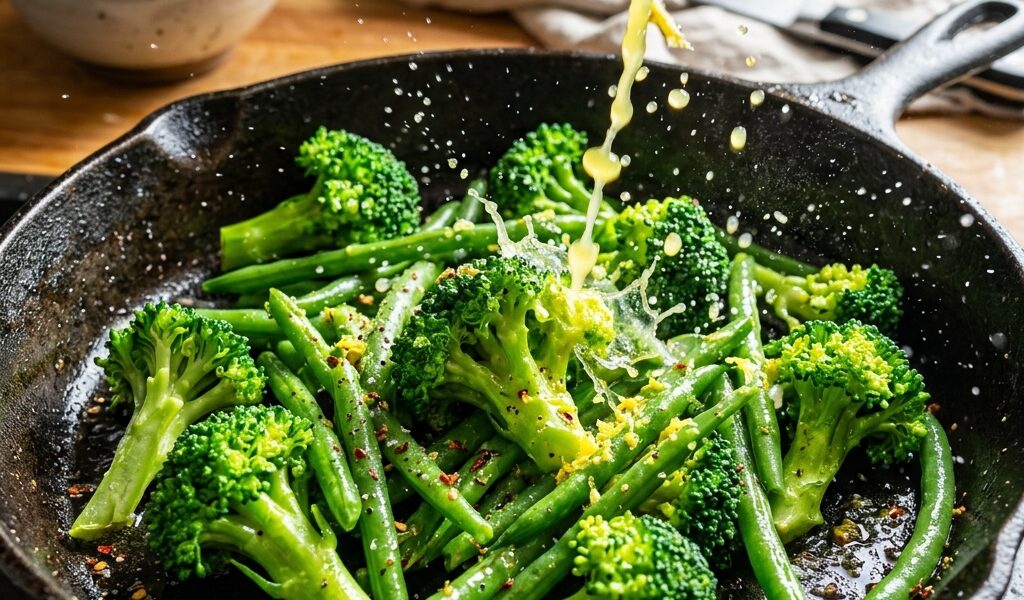
Rien n’est plus triste dans une assiette que des haricots verts ou des brocolis cuits qui ont pris une couleur vert olive terne ou marronâtre. Conserver cette couleur verte éclatante après cuisson est un défi permanent en cuisine. De nombreux chefs recommandent d’utiliser du jus de citron pour fixer la couleur. Mais à quel moment exact de la cuisson faut-il l’ajouter pour ne pas provoquer l’effet inverse ?
Réponse rapide : Pour fixer la couleur éclatante des légumes verts, ajoutez un filet de jus de citron frais uniquement après la cuisson (juste au moment de servir) ou plongez-les immédiatement dans un bain d’eau glacée citronnée après une cuisson rapide à l’anglaise. N’ajoutez jamais de jus de citron dans l’eau de cuisson : l’acide citrique chaud détruit la chlorophylle et brunit les légumes instantanément.
L’explication scientifique : Chlorophylle, phéophytine, libération d’acides et choc thermique
La couleur verte des légumes provient de la chlorophylle, un pigment situé dans les chloroplastes des cellules végétales. La molécule de chlorophylle possède en son centre un anneau de porphyrine contenant un ion magnésium (Mg2+). C’est cet ion magnésium qui donne sa couleur vert vif caractéristique au pigment.
Pendant la cuisson, les parois cellulaires des légumes éclatent, libérant les acides organiques naturellement présents dans le végétal. Si la cuisson dure trop longtemps ou se fait dans un milieu acide (eau additionnée de jus de citron), les ions hydrogène (H+) de l’acide remplacent l’ion magnésium au centre de la molécule de chlorophylle. Ce remplacement transforme la chlorophylle en phéophytine, un composé de couleur vert olive terne ou marron. Pour éviter cela, on cuit les légumes rapidement dans un grand volume d’eau bouillante salée (le sel stabilise la structure et l’eau dilue les acides végétaux libérés). L’ajout de jus de citron froid après cuisson, une fois la structure cellulaire figée et refroidie, n’affecte plus la chlorophylle interne de la même manière et apporte une brillance de surface en agissant comme un vernis antioxydant protecteur.
Retour d’expérience : Mes haricots verts impeccables au buffet
Devant préparer un grand buffet froid pour un événement familial, je devais cuire 3 kg de haricots verts à l’avance tout en veillant à ce qu’ils restent bien verts sur le plat de service. J’ai appliqué la technique en deux étapes : d’abord, une cuisson rapide de 6 minutes dans une grande marmite d’eau bouillante salée. Dès la fin de la cuisson, j’ai plongé les haricots dans un grand saladier d’eau glacée contenant des glaçons et 50 ml de jus de citron. Le froid a stoppé net la cuisson et fixé le vert éclatant, tandis que le jus de citron a agi en protégeant les pigments de l’oxydation de l’air. Avant de servir, j’ai simplement arrosé les haricots d’un filet d’huile d’olive et de quelques gouttes de jus de citron frais. Ils sont restés d’un vert forêt magnifique toute la soirée.
Conclusion
La chlorophylle des légumes verts est extrêmement sensible aux acides à chaud. Bannissez le citron durant la phase de cuisson et utilisez-le uniquement à froid en finition pour magnifier la couleur et la fraîcheur de vos plats.