Empêcher les fruits et légumes de noircir : le pouvoir antioxydant du jus de citron
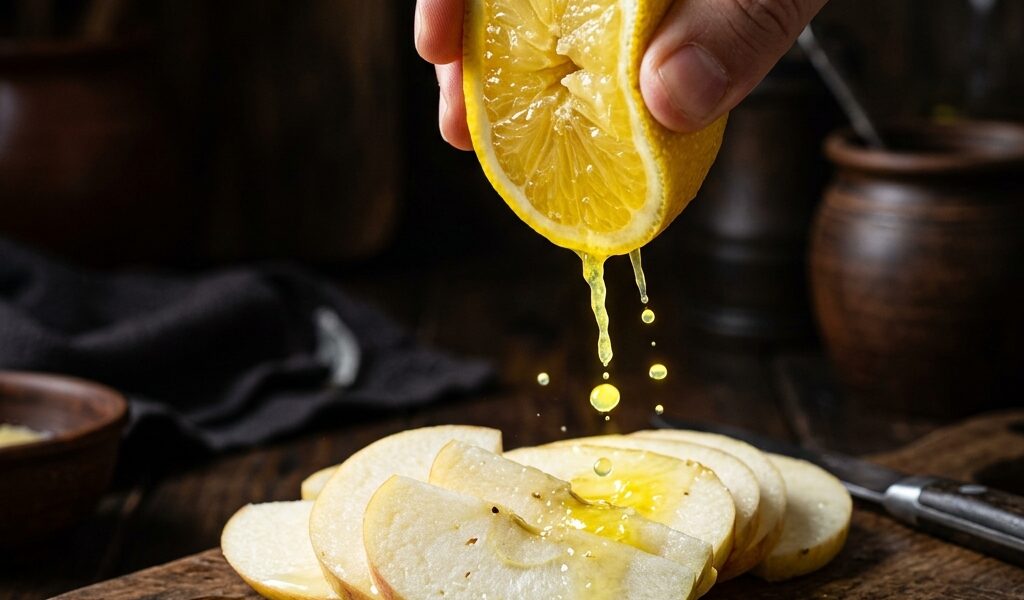
Qui n’a jamais vu une belle salade de fruits ou des morceaux d’avocat fraîchement coupés prendre une couleur brune peu appétissante en seulement quelques minutes ? Ce phénomène esthétiquement fâcheux est le cauchemar des cuisiniers. Heureusement, un simple trait de jus de citron suffit à stopper net ce processus. Comment cette solution acide agit-elle au niveau moléculaire pour préserver les couleurs éclatantes de nos fruits et légumes ?
Réponse rapide : Le jus de citron empêche le brunissement des végétaux grâce à sa double action : son acidité extrême (pH de 2) désactive les enzymes responsables du brunissement (les polyphénol oxydases), tandis que son acide ascorbique (vitamine C) agit comme un réducteur chimique qui reconvertit les composés oxydés en molécules incolores. C’est l’antioxydant naturel par excellence en cuisine.
L’explication scientifique : Polyphénol oxydase, quinones et réduction de l’acide ascorbique
Le brunissement d’un fruit coupé (comme la pomme, la poire ou l’avocat) est une réaction d’oxydation enzymatique. Lorsque les cellules végétales sont brisées par la coupe, les composés phénoliques stockés dans les vacuoles entrent en contact avec la polyphénol oxydase (PPO) présente dans le cytoplasme, en présence de l’oxygène de l’air. La PPO catalyse d’abord l’hydroxylation des monophénols en o-diphénols, puis leur oxydation en o-quinones.
Les o-quinones sont des molécules hautement réactives qui polymérisent spontanément pour former des pigments bruns appelés mélanines. Le jus de citron stoppe cette cascade de deux manières : 1. **L’effet pH** : La PPO possède une activité optimale à un pH compris entre 6,0 et 7,0, et est totalement inactivée (dénaturation de sa structure protéique tridimensionnelle) en dessous d’un pH de 3,0. L’acide citrique du jus de citron abaisse le pH de la surface coupée en dessous de 2,5, bloquant instantanément l’action catalytique de l’enzyme. 2. **L’effet réducteur** : L’acide l-ascorbique (vitamine C) a un potentiel d’oxydoréduction inférieur à celui des quinones. Il agit comme un donneur d’électrons en réduisant les o-quinones formées pour les transformer à nouveau en o-diphénols incolores avant qu’elles ne puissent polymériser en mélanines brunes. Tant qu’il reste de la vitamine C active à la surface du végétal, aucun pigment brun ne peut s’accumuler.
Retour d’expérience : Ma méthode pour les avocats et les pommes
Adepte du “Meal Prep” (préparation des repas à l’avance), j’ai longtemps cherché à conserver mes morceaux d’avocat pour mes salades du midi sans qu’ils ne virent au noir. J’ai comparé l’aspersion simple d’eau froide avec le badigeon d’un filet de jus de citron bio frais. Le résultat est sans appel : les avocats aspergés d’eau brunissent après 2 heures ; ceux badigeonnés au citron restent d’un vert éclatant pendant plus de 24 heures au réfrigérateur dans une boîte hermétique. L’astuce est d’utiliser un petit pinceau en silicone pour appliquer le jus de citron de manière homogène sur toute la surface de coupe sans détremper la chair. Pour les pommes, je les plonge dans un saladier d’eau additionnée de 10 % de jus de citron pendant 30 secondes avant de les égoutter : elles restent impeccables pour les tartes ou les collations.
Conclusion
Le jus de citron est un additif de conservation naturel et redoutablement efficace en cuisine grâce à l’inactivation de la PME et au pouvoir réducteur de l’acide ascorbique. C’est l’alternative biologique idéale aux sulfites industriels.